


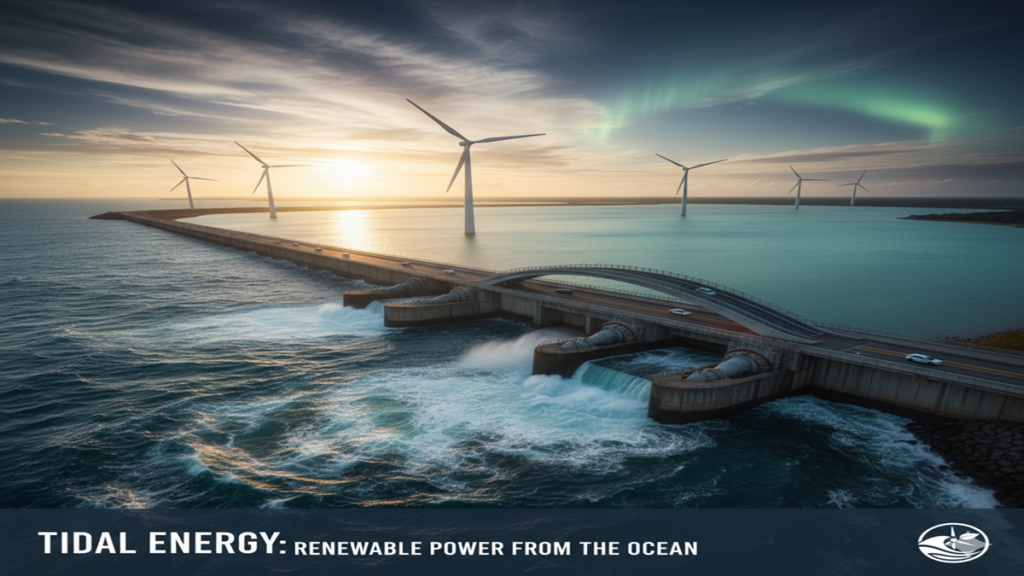
Tidal Energy Renewable Source: समुद्र की लहरों से बिजली! जानिए ज्वारीय ऊर्जा के फायदे, कार्यप्रणाली और भविष्य की संभावनाएं।
Tidal Energy Renewable Source: Introduction: आज की दुनिया तेजी से जलवायु परिवर्तन (Climate Change) की चुनौतियों का सामना कर रही है। ऐसे में कोयले और पेट्रोल जैसे जीवाश्म ईंधनों पर निर्भरता कम करना अनिवार्य हो गया है। जब हम अक्षय ऊर्जा (Renewable Energy) की बात करते हैं, तो अक्सर हमारे दिमाग में सौर ऊर्जा या पवन ऊर्जा का नाम आता है। लेकिन एक और शक्तिशाली स्रोत है जो 24 घंटे उपलब्ध है— ज्वारीय ऊर्जा (Tidal Energy)।
यदि आप जानना चाहते हैं कि “Tidal Energy Renewable Source” के रूप में कितनी प्रभावी है, तो यह लेख आपके लिए है। आज 2 अप्रैल 2026 की ताजा तकनीक और वैश्विक ऊर्जा रिपोर्ट के आधार पर, हम समझेंगे कि कैसे समुद्र की लहरें हमारे घरों को रोशन कर सकती हैं।.
1. ज्वारीय ऊर्जा क्या है? (What is Tidal Energy?)
Tidal Energy Renewable Source: ज्वारीय ऊर्जा वह ऊर्जा है जो समुद्र में आने वाले ज्वार-भाटा (Tides) से प्राप्त होती है। ज्वार-भाटा मुख्य रूप से पृथ्वी पर चंद्रमा और सूर्य के गुरुत्वाकर्षण खिंचाव (Gravitational Pull) के कारण आते हैं। चूंकि समुद्र का स्तर दिन में दो बार ऊपर उठता और नीचे गिरता है, इस गतिज ऊर्जा (Kinetic Energy) को टर्बाइनों के माध्यम से बिजली में बदला जाता है।
2. यह कैसे काम करती है? (How it Works?)
Tidal Energy Renewable Source: ज्वारीय ऊर्जा उत्पन्न करने के मुख्य रूप से तीन तरीके हैं:
- ज्वारीय धारा टर्बाइन (Tidal Stream Turbines): ये पवन चक्कियों की तरह होती हैं लेकिन पानी के नीचे स्थित होती हैं। पानी का घनत्व हवा से अधिक होता है, इसलिए ये टर्बाइन बहुत कम गति पर भी अधिक बिजली पैदा कर सकती हैं।
- ज्वारीय बैराज (Tidal Barrages): यह समुद्र की खाड़ी या नदी के मुहाने पर बने बांध जैसा होता है। जब ज्वार आता है, तो पानी बांध के पीछे जमा हो जाता है और वापस जाते समय टर्बाइनों को घुमाता है।
- ज्वारीय लैगून (Tidal Lagoons): यह एक कृत्रिम घेरा होता है जो समुद्र के किनारे बनाया जाता है, जिससे पर्यावरण को नुकसान पहुँचाए बिना बिजली बनाई जा सकती है।
3. ज्वारीय ऊर्जा के फायदे (Advantages of Tidal Energy)
- 100% नवीकरणीय (Renewable): यह कभी खत्म न होने वाला स्रोत है क्योंकि ज्वार-भाटा हमेशा आते रहेंगे।
- भविष्यवाणी के योग्य (Predictable): सूरज कब निकलेगा या हवा कब चलेगी, यह पक्का नहीं होता। लेकिन ज्वार-भाटा कब आएगा, इसकी गणना सालों पहले सटीक रूप से की जा सकती है।
- उच्च ऊर्जा घनत्व (High Energy Density): पानी हवा की तुलना में 800 गुना अधिक सघन होता है, इसलिए ज्वारीय टर्बाइन सौर पैनलों की तुलना में बहुत कम जगह में अधिक बिजली पैदा करती हैं।
- कार्बन मुक्त: यह संचालन के दौरान कोई ग्रीनहाउस गैस उत्सर्जित नहीं करती।
4. चुनौतियां और नुकसान (Challenges)
Tidal Energy Renewable Source: इतने फायदों के बावजूद, Tidal Energy Renewable Source के रूप में अभी भी कुछ चुनौतियों का सामना कर रही है:
- उच्च स्थापना लागत: समुद्र के भीतर संरचनाएं बनाना और उनका रखरखाव करना बहुत महंगा होता है।
- समुद्री जीवन पर प्रभाव: टर्बाइनों से मछलियों और अन्य समुद्री जीवों को खतरा हो सकता है।
- स्थान की सीमा: यह तकनीक केवल तटीय क्षेत्रों (Coastal Areas) में ही सफल है।
5. भारत में ज्वारीय ऊर्जा की संभावनाएं (Scope in India)
Tidal Energy Renewable Source: भारत की लगभग 7,500 किमी लंबी तटरेखा है, जो ज्वारीय ऊर्जा के लिए बहुत बड़ी संभावना प्रदान करती है।
- गुजरात (खंभात की खाड़ी और कच्छ की खाड़ी): यहाँ भारत की सबसे अधिक ज्वारीय ऊर्जा क्षमता है।
- पश्चिम बंगाल (सुंदरवन): यहाँ भी कई छोटे प्रोजेक्ट्स पर काम चल रहा है। 2026 तक, भारत सरकार अपनी नई अक्षय ऊर्जा नीति के तहत समुद्र-आधारित ऊर्जा स्रोतों पर शोध और निवेश बढ़ा रही है।
4. अक्सर पूछे जाने वाले प्रश्न (FAQs)
Q1: क्या ज्वारीय ऊर्जा सौर ऊर्जा से बेहतर है?
Ans: दोनों के अपने फायदे हैं। सौर ऊर्जा सस्ती है, लेकिन ज्वारीय ऊर्जा 24/7 और अधिक स्थिर (Stable) है क्योंकि ज्वार-भाटा का समय निश्चित होता है।
Q2: ज्वारीय ऊर्जा का मुख्य स्रोत क्या है?
Ans: इसका मुख्य स्रोत चंद्रमा और सूर्य का गुरुत्वाकर्षण बल है, जो समुद्र के पानी को ऊपर और नीचे ले जाता है।
Q3: क्या ज्वारीय ऊर्जा पर्यावरण के अनुकूल है?
Ans: हाँ, यह पूरी तरह से स्वच्छ ऊर्जा है। हालांकि, निर्माण के समय समुद्री पारिस्थितिकी तंत्र का ध्यान रखना जरूरी होता है।
Conclusion: एक स्वच्छ भविष्य की ओर!
Tidal Energy Renewable Source के रूप में आने वाले समय में ऊर्जा के संकट को हल करने में बड़ी भूमिका निभा सकती है। जैसे-जैसे तकनीक सस्ती होगी, हम देखेंगे कि समुद्र की लहरें न केवल हमारे तटों को छुएंगी बल्कि हमारे जीवन को भी ऊर्जावान बनाएंगी। अक्षय ऊर्जा के इस अद्भुत स्रोत का समर्थन करना और इसके बारे में जागरूकता फैलाना आज की जरूरत है।
The Unyielding Pulse: Harnessing the Moon’s Rhythm for a Sustainable Future
Tidal Energy Renewable Source For millennia, humanity has lived in thrall to the ocean’s tides, dictated by their immutable schedule. These vast, aqueous pulses, driven by the celestial dance of the moon and sun, have shaped coastlines, guided explorers, and inspired myth. Today, we stand at a technological frontier where we no longer merely observe this rhythm but seek to harness its monumental power.
Tidal energy, a formidable and predictable subset of ocean energy, emerges not as a futuristic fantasy, but as a credible, clean, and consistent contender in the global renewable energy portfolio. This article delves into the mechanics, potential, challenges, and future of turning lunar gravity into electricity.
The Celestial Engine: Understanding the Source
Tidal Energy Renewable Source: Unlike the variable whispers of wind and the diurnal intermittency of solar power, tidal energy is born from astronomical certainty. The gravitational pull of the moon, and to a lesser extent the sun, exerts a force on the Earth’s oceans, creating bulges of water. As the Earth rotates, these bulges manifest as the predictable rise (flood) and fall (ebb) of sea levels—the tides. The magnitude of this movement, the tidal range, is amplified by the geography of coastlines and seabeds, with some locations experiencing dramatic differences between high and low tide.
Tidal Energy Renewable Source: This predictability is tidal energy’s supreme advantage. Grid operators can forecast energy output decades in advance with extraordinary accuracy, a stark contrast to the balancing act required for weather-dependent sources. The energy density of water, approximately 832 times that of air, means that even slow-moving tidal currents carry immense kinetic force, allowing for potentially greater power generation from smaller, more compact turbine systems compared to their wind counterparts.
Engineering the Current: Key Technologies
Tidal Energy Renewable Source: Harnessing this power requires robust technologies designed to withstand a harsh and corrosive marine environment. There are three primary methods of extraction:
1. Tidal Stream Generators (Tidal Turbines):
Tidal Energy Renewable Source: Often likened to underwater windmills, these are the most dynamic and rapidly developing technology. Arrays of turbines, mounted on the seabed or on floating platforms, are positioned in areas with strong tidal currents, typically in narrow channels, straits, or between islands. As the tide flows in and out, the current turns the turbine blades, driving a generator. Modern designs include horizontal-axis turbines (similar to wind turbines), vertical-axis turbines, and innovative oscillating hydrofoils that generate lift from the current. Projects like the MeyGen array in the Pentland Firth, Scotland, exemplify this approach, aiming to power thousands of homes from the fierce currents of the North Sea.
2. Tidal Barrages:
Tidal Energy Renewable Source: The oldest and most large-scale method, barrages are dams built across the mouths of tidal estuaries or bays. They incorporate sluice gates and low-head turbines, typically of the Kaplan or bulb type. Operation follows a simple cycle: gates are opened to allow the incoming tide to fill the basin, then closed. As the tide recedes outside the barrage, a height differential (head) is created. Water is then released through the turbines back to the sea, generating electricity.
The iconic La Rance Tidal Power Station in France, operational since 1966, stands as a testament to barrage technology’s longevity, with a capacity of 240 MW. However, their massive infrastructure, high capital costs, and significant environmental footprint have made barrages a less favored option in recent years.
3. Tidal Lagoons:
Tidal Energy Renewable Source: A proposed compromise that seeks to capture the benefits of barrages while mitigating their ecological impact. A tidal lagoon is an artificial, contained body of water constructed from natural materials like rock, situated on the shoreline. It operates on the same principle of creating a head difference but does not block an entire estuary. By being independent of the coastline, proponents argue lagoons can reduce impacts on sedimentation and fish migration. The proposed Swansea Bay Tidal Lagoon in the UK was a flagship project for this technology, though it has faced significant financial and political hurdles.
The Powerful Allure: Advantages of Tidal Power
- Predictability and Reliability: The “baseload” characteristic of tidal energy is its crown jewel. Exact output schedules allow for seamless integration into the energy grid, providing a stable complement to more intermittent renewables.
- High Energy Density: Water’s density enables high power output from relatively small turbine swept areas, leading to potentially smaller infrastructure footprints per megawatt generated compared to wind or solar farms.
- Long Lifespan and Low Operational Costs: Once installed, tidal energy plants, particularly barrages, have extraordinarily long lifespans (La Rance is projected to operate for over a century). The “fuel” is free and perpetual, and while maintenance can be challenging, the long-term operational costs are competitive.
- Low Visual Impact: Submerged tidal stream devices are largely invisible from the shore, avoiding the visual pollution concerns sometimes associated with wind farms or large solar arrays.
- Contributing to Energy Security: Tidal resources are indigenous, reducing reliance on imported fossil fuels and enhancing national energy security for coastal nations.
Navigating Choppy Waters: Challenges and Environmental Considerations
Tidal Energy Renewable Source: The path to commercial-scale tidal energy is not without formidable obstacles.
- High Capital Costs and Technological Risk: The marine environment is one of the most hostile on Earth. Engineering structures to survive storm surges, saline corrosion, and biofouling requires expensive, specialized materials and complex installation processes, leading to steep upfront costs.
- Environmental Impacts: While emissions-free in operation, the ecological consequences must be carefully managed. Tidal barrages can alter tidal regimes, impact sedimentation (potentially affecting intertidal habitats like mudflats and salt marshes), and impede the migration of marine life. Tidal stream turbines pose risks of collision with marine animals, though research suggests most marine mammals and fish can avoid slow-moving blades. The noise during construction and operation also requires study and mitigation.
- Tidal Energy Renewable Source: Grid Connection and Limited Suitable Sites: The best tidal resources are often in remote locations, necessitating expensive underwater cable links to the main grid. Furthermore, sites with a tidal range exceeding 5 meters or currents stronger than 2-2.5 m/s are geographically limited globally.
- Regulatory and Funding Hurdles: The nascent industry faces complex marine spatial planning, licensing, and consenting processes. Securing large-scale investment for unproven-at-scale technologies remains a significant challenge, often requiring substantial government support.
The Future Tide: Innovation and Global Potential
Tidal Energy Renewable Source: Despite the challenges, innovation is surging. The focus is on Tidal Stream technology, with companies developing next-generation turbines that are lighter, more efficient, easier to install and maintain, and cheaper to build. Innovations like floating turbine platforms that can be towed to shore for servicing, and biomimetic designs that reduce cavitation and noise, are promising.
The global resource is substantial. The theoretical worldwide potential of tidal power is estimated to be significant, with hotspots in:
- The United Kingdom: Particularly around Scotland and the Channel Islands.
- France: The legacy of La Rance and the powerful currents of Normandy.
- Canada: The Bay of Fundy, home to the world’s highest tides.
- South Korea: With its western coastline and existing tidal barrage projects.
- China, Russia, Chile, and the USA (Alaska) also possess considerable resources.
Tidal Energy Renewable Source: The future likely lies in tidal stream arrays becoming a standardized, cost-competitive technology, and in the development of hybrid marine renewable platforms that combine tidal, wave, and offshore wind power, sharing infrastructure and grid connections to maximize energy yield and economic viability.
Conclusion: A Rhythm for the Anthropocene
Tidal Energy Renewable Source: Tidal energy represents more than just another renewable technology; it symbolizes a deeper alignment with the natural systems of our planet. It offers a lesson in working with relentless, cyclical forces rather than battling unpredictable ones. While it will not be the sole solution to the climate crisis, its role as a predictable, dense, and long-lasting source of clean power is undeniable.
Tidal Energy Renewable Source: The challenge ahead is one of engineering perseverance, environmental stewardship, and political will. By investing in research, developing robust environmental monitoring frameworks, and creating supportive policy environments, we can unlock the power of the tides. In doing so, we tap into an ancient rhythm, using the moon’s timeless pull to illuminate our cities and power our future, ensuring that the relentless pulse of the ocean becomes a steady heartbeat for a sustainable civilization.
Frequently Asked Questions (FAQs)
1. Is tidal energy truly renewable and sustainable?
Tidal Energy Renewable Source: Yes, tidal energy is a renewable resource. Its source is the gravitational interaction between the Earth, moon, and sun, which will continue for billions of years. It produces zero greenhouse gas emissions during operation. “Sustainability,” however, also encompasses environmental and social impacts. While the energy source is inexhaustible, the sustainability of each project depends on careful site selection, technology choice, and mitigation of local ecological effects, such as on sediment flow and marine life.
2. Why isn’t tidal energy more widely used if it’s so predictable?
Tidal Energy Renewable Source: The main barriers are high initial costs and technological immaturity at scale. The extreme marine environment makes devices expensive to build, install, and maintain. While predictable, the number of locations worldwide with a strong enough tidal range or current speed to be economically viable is limited. Furthermore, as a younger technology than wind or solar, it hasn’t yet benefited from the same dramatic cost reductions that come from mass manufacturing and deployment (the “learning curve”).
3. How does tidal energy compare to wind and solar power?
- Tidal Energy Renewable Source: Predictability: Tidal wins decisively. Tides are perfectly predictable, while wind and solar are weather-dependent and variable.
- Energy Density: Tidal has a much higher energy density, meaning more power can be generated from a smaller area.
- Intermittency: Solar produces only during the day, wind is irregular. Tidal cycles produce energy roughly four times a day, but these periods shift with the lunar cycle. It’s intermittent but perfectly scheduled.
- Tidal is in an earlier commercial stage.
- Environmental Footprint: All have site-specific impacts. Tidal’s are less well-understood than those of terrestrial wind and solar.
4. What are the biggest environmental concerns with tidal turbines?
Tidal Energy Renewable Source: The primary concerns for tidal stream turbines (not barrages) are:
- Collision Risk: The potential for marine animals (fish, mammals, diving birds) to strike the turbine blades. Current evidence suggests the risk is low due to slow blade speeds and animal avoidance behaviors, but monitoring is ongoing.
- Underwater Noise: Noise from construction (pile-driving) and operation could affect marine species that use sound for communication and navigation. Technological advances are reducing operational noise.
- Electromagnetic Fields (EMFs): Cables on the seabed emit low-level EMFs, which could potentially affect sensitive species like sharks and rays.
- Habitat Change: The structures can act as artificial reefs, altering local ecosystems.
5. When will tidal energy become a major global energy source?
Tidal Energy Renewable Source: Most experts believe tidal stream energy will begin to scale significantly in the 2030s. This decade is critical for demonstrating large-scale arrays (hundreds of MW), driving down costs through innovation and economies of scale, and establishing clear regulatory pathways. Its ultimate role will likely be as a specialized, high-value complement to other renewables, providing predictable power in specific coastal regions with strong resources, rather than a ubiquitous global source like solar. Its contribution to a diversified, resilient, and zero-carbon grid, however, could be vital.