


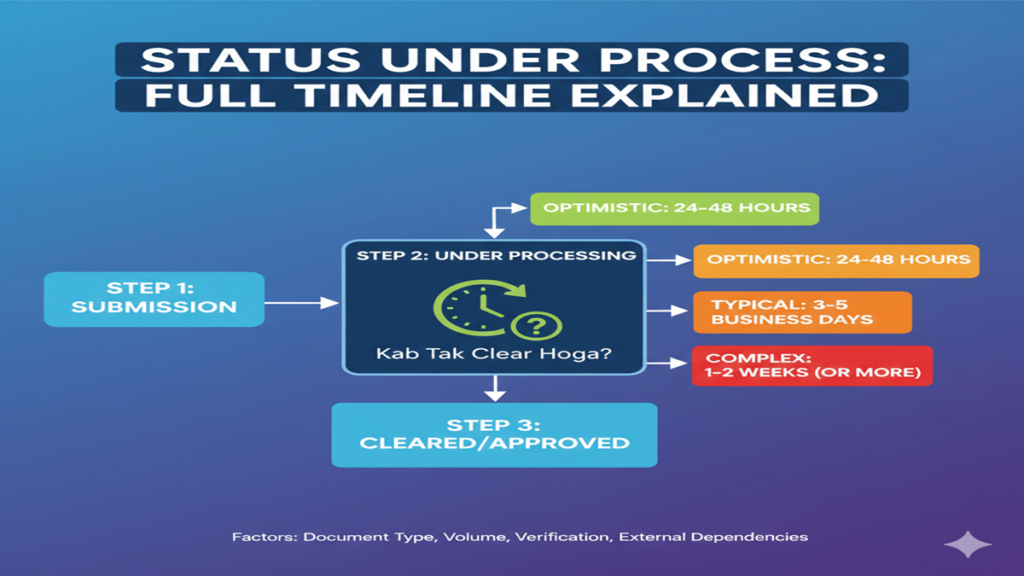
Status Under Process Kab Tak? जानें आवेदन ‘अंडर प्रोसेस’ होने का असली मतलब और इसे ठीक करने का तरीका!
Introduction:
Status Under Process Kab Tak? 2026: आजकल लगभग सभी सरकारी और निजी सेवाएं ऑनलाइन हो गई हैं। चाहे वह पीएम किसान योजना की किश्त हो, लाड़ली बहना योजना का लाभ हो, या फिर पीएफ (PF) निकालना हो—फॉर्म भरने के बाद जब हम स्टेटस चेक करते हैं, तो अक्सर एक ही संदेश दिखाई देता है: “Status Under Process”।
यह संदेश देखकर मन में सवाल उठता है कि आखिर “Status Under Process Kab Tak” रहेगा? क्या फॉर्म रिजेक्ट हो गया है? या पैसे आने में अभी और समय लगेगा? इस लेख में हम आपके इन सभी सवालों के जवाब देंगे और बताएंगे कि अलग-अलग योजनाओं में इस स्टेटस का क्या मतलब होता है।
1. ‘Status Under Process’ का क्या मतलब है? (What does it mean?)
Status Under Process Kab Tak? 2026: जब आपके स्टेटस में ‘Under Process’ लिखा आता है, तो इसका सीधा मतलब है कि आपका आवेदन संबंधित विभाग को मिल चुका है और वर्तमान में उसकी जांच (Verification) चल रही है।
- इसका मतलब यह कतई नहीं है कि आपका फॉर्म रिजेक्ट हो गया है।
- इसका मतलब यह है कि आपके द्वारा दी गई जानकारी (जैसे आधार, बैंक खाता, पात्रता) को सिस्टम द्वारा क्रॉस-चेक किया जा रहा है।
2. अलग-अलग सेवाओं में कितना समय लगता है? (Estimated Time Table)
Status Under Process Kab Tak? 2026: विभिन्न सरकारी कार्यों में ‘Under Process’ रहने की अवधि अलग-अलग होती है:
| सेवा का नाम (Service) | स्टेटस का समय (Estimated Time) |
| PF Withdrawal (EPFO) | 7 से 15 कार्य दिवस (Working Days) |
| Passport Application | 10 से 30 दिन (पुलिस वेरिफिकेशन के आधार पर) |
| PM Kisan Payment | 15 से 45 दिन (किश्त जारी होने से पहले) |
| Scholarship (UP/Bihar) | 1 से 3 महीने (वेरिफिकेशन स्टेज के अनुसार) |
| PAN Card/Aadhaar Update | 5 से 10 कार्य दिवस |
3. स्टेटस ‘अंडर प्रोसेस’ होने के मुख्य कारण (Why it stays Under Process?)
Status Under Process Kab Tak? 2026: अगर आपका स्टेटस उम्मीद से ज्यादा समय तक ‘Under Process’ दिखा रहा है, तो इसके पीछे ये कारण हो सकते हैं:
- भारी ट्रैफिक (High Volume): जब एक साथ लाखों लोग आवेदन करते हैं, तो सर्वर और अधिकारियों पर काम का बोझ बढ़ जाता है।
- दस्तावेजों की कमी: यदि आपके द्वारा अपलोड किए गए दस्तावेज स्पष्ट नहीं हैं, तो अधिकारी उन्हें दोबारा चेक करने के लिए पेंडिंग में डाल देते हैं।
- बैंक सर्वर की समस्या: यदि पैसा भेजा जा रहा है (Payment Under Process), तो बैंक के सर्वर में देरी के कारण स्टेटस अटक सकता है।
- छुट्टियां (Government Holidays): सरकारी दफ्तरों में छुट्टियों के कारण भी काम धीमा हो जाता है।
4. अगर स्टेटस नहीं बदल रहा, तो क्या करें? (What to do?)
Status Under Process Kab Tak? 2026: यदि आपका स्टेटस 15-20 दिनों से अधिक समय तक ‘Under Process’ है, तो आप निम्नलिखित कदम उठा सकते हैं:
- हेल्पलाइन नंबर: संबंधित विभाग के टोल-फ्री नंबर पर कॉल करें और अपने आवेदन की स्थिति पूछें।
- Grievance Portal: भारत सरकार के ‘CPGRAMS’ पोर्टल पर अपनी शिकायत दर्ज करें।
- नजदीकी कार्यालय: यदि संभव हो, तो अपने जिले के संबंधित कार्यालय (जैसे ब्लॉक, तहसील या बैंक) में जाकर स्टेटस दिखाएं।
- Status Refresh: कभी-कभी पोर्टल अपडेट नहीं होता, इसलिए ब्राउज़र का कैश (Cache) क्लियर करके दोबारा चेक करें।
5. बैंक पेमेंट ‘Under Process’ होने पर क्या करें?
Status Under Process Kab Tak? 2026: अक्सर ‘Payment Under Process’ का मतलब होता है कि विभाग ने पैसा रिलीज कर दिया है, लेकिन वह अभी आपके बैंक खाते में जमा नहीं हुआ है। इसके लिए अपना NPCI Mapping और Aadhaar Seeding जरूर चेक करें। अगर बैंक खाता आधार से लिंक नहीं है, तो पैसा ‘Under Process’ ही रहेगा।
4. अक्सर पूछे जाने वाले प्रश्न (FAQs)
Q1: क्या ‘Under Process’ का मतलब है कि पैसा मिलेगा?
Ans: हाँ, यदि आपके सभी दस्तावेज सही हैं, तो ‘Under Process’ के बाद ‘Approved’ या ‘Success’ का स्टेटस आता है और आपको लाभ मिलता है।
Q2: PF का स्टेटस 10 दिन से ‘Under Process’ है, क्या करूँ?
Ans: पीएफ सेटलमेंट में आमतौर पर 7-15 दिन लगते हैं। 20 दिन होने पर आप ईपीएफओ (EPFO) की वेबसाइट पर शिकायत दर्ज कर सकते हैं।
Q3: क्या मैं अपना ‘Under Process’ फॉर्म दोबारा भर सकता हूँ?
Ans: नहीं, जब तक पुराना आवेदन प्रोसेस में है, आप उसी सर्विस के लिए दोबारा अप्लाई न करें, वरना दोनों फॉर्म रिजेक्ट हो सकते हैं।
Conclusion: धैर्य रखें और चेक करते रहें!
“Status Under Process Kab Tak” का कोई एक निश्चित जवाब नहीं है, क्योंकि यह विभाग और आपकी जानकारी की सटीकता पर निर्भर करता है। सामान्य तौर पर, अधिकांश मामलों में यह 15 से 20 दिनों में ठीक हो जाता है। यदि समय बहुत अधिक हो गया है, तो संबंधित विभाग से संपर्क करना ही सबसे अच्छा विकल्प है।
Decoding “Under Process”: Your Complete Timeline and Clarity Guide
Status Under Process Kab Tak Clear Hoga? Full Timeline Explained. If you have ever applied for a visa, a government service, or a financial claim like those from India’s EPFO (Employees’ Provident Fund Organization), you have likely encountered the dreaded “Under Process” or “In Process” status. It is a black hole of information. You know your application is somewhere in the system, but you have no idea what is happening, who is looking at it, or—most importantly—“Status under process kab tak clear hoga?” (When will it be cleared?).
This comprehensive guide pulls back the curtain on this ambiguous status. We will explain exactly what it means, break down the hidden stages your application goes through, and provide a realistic, phased timeline for when you can expect a final outcome.
Status Under Process Kab Tak Clear Hoga? Full Timeline Explained.
What Does “Under Process” Actually Mean?
Status Under Process Kab Tak Clear Hoga? Full Timeline Explained. At its core, the “Under Process” status is a catch-all term used by government agencies and large organizations to indicate that your application has been received and is actively within their system . It is a confirmation that your file is no longer in the waiting room; it has been called in for review.
However, the nuance is critical. According to experts analyzing systems like Canada’s immigration portal, this status rarely means an officer is actively reading your file at that very second . Instead, it signifies that your application has passed the initial triage and has been placed in the queue for a specific processing stream.
What it usually means:
- Your documents have passed a初步 (initial) check for completeness.
- Your application has been digitally logged and assigned to a processing center or office.
- It is now waiting for a human officer to pick it up for detailed scrutiny .
- It will remain in this state until a final decision is made—whether that is approval, rejection, or a request for more information .
In many ways, seeing “Under Process” is actually good news. It means your application wasn’t rejected immediately due to incompleteness. It is now in the system’s workflow .
The Indian Context: The EPFO “Under Process” Timeline
Status Under Process Kab Tak Clear Hoga? Full Timeline Explained. To make this guide practical, let’s apply it to one of the most common and anxiety-inducing scenarios for Indian citizens: the EPFO PF (Provident Fund) claim. When you file for a PF withdrawal (Form 19, 10C, or 31), you track your claim through a portal. The status changes from “Submitted” to “Sent to Field Office,” and finally to “Under Process” .
This is where most people get stuck. So, “EPFO Under Process kab tak clear hoga?”
Based on user experiences and standard operating procedures, the “Under Process” stage for an EPFO claim is not a single step but a series of sub-steps. Here is the full timeline explained.
Phase 1: The Arrival and Queue (Days 1-7 after status change)
Status Under Process Kab Tak Clear Hoga? Full Timeline Explained. When your status changes to “Under Process,” it means the physical or digital file has reached the hands of the specific field office that handles your company’s accounts (e.g., Bandra Mumbai, Gurgaon) .
- What’s happening: The office has received the claim. It is sorted and assigned to a Claims Assistant. However, with thousands of claims pending, your file goes into a digital or physical queue.
- User Experience: You see “Under Process,” but nothing happens for the first few days. This is normal.
Phase 2: Scrutiny and Verification (Days 7-20)
Status Under Process Kab Tak? 2026: This is the core of the “Under Process” status. The assigned officer finally opens your file.
- What’s happening:
- Document Matching: The officer checks if the name, date of birth, and father’s name on your claim match the KYC (Know Your Customer) details in the system (Aadhaar, PAN, Bank).
- Bank Verification: They verify if your bank account is correctly seeded with your UAN (Universal Account Number).
- Employer Compliance: In some cases, the system may require a digital sign-off from your previous employer to confirm that you have actually left the company.
- Timeline Insight: Reddit users have noted that after approximately 15-18 days from the claim date, the status often moves from “Sent to Field Office” to “Under Process,” and then remains there for another 1-2 weeks . One user from Mumbai was told by officials to expect 20 working days (excluding weekends and holidays) from the time the status appears .
Phase 3: Approval and Settlement (Days 20-30)
Status Under Process Kab Tak Clear Hoga? Full Timeline Explained. If no discrepancies are found, the officer approves the claim.
- What’s happening: The approval triggers a transfer request to the bank. You may receive an SMS stating, “Your claim is approved and will be settled shortly” .
- Final Step: The money is credited to your account. This usually takes another 2-5 business days after approval.
- The “Holiday” Factor: Remember that government offices observe regional and national holidays. A claim filed in March might face delays due to financial year-end closing, while a claim in December might be slowed by Christmas and New Year holidays .
EPFO Summary: From the moment you see “Under Process,” you should budget approximately 3 to 4 weeks for the money to hit your account, assuming no errors.
Global Parallels: How Other Countries Define “Processing”
Status Under Process Kab Tak Clear Hoga? Full Timeline Explained. To further understand the timeline, it helps to look at how other governments define their processing stages. This shows that the “Under Process” wait time is a universal phenomenon.
1. The “Queue” System (Canada & Finland)
Status Under Process Kab Tak? 2026: In Canada, the IRCC explicitly states that the progress bar on your application is based on overall processing times for that category, not the specific progress of your file. Your application can be “In Process” while waiting for background checks that happen in the background .
Similarly, the Finnish A-Kassa (Unemployment Fund) distinguishes between “Received” (waiting in line) and “In Process” (being handled by a processor). They publish the date of applications currently being processed, so you can see how close they are to yours .
2. The “Clarification” Loop (Singapore & USA)
Status Under Process Kab Tak? 2026: Sometimes, “Under Process” hides a request for more information. In Singapore’s LSRA e-Services, the status “Pending Further Information” indicates they are waiting for you to respond, which pauses the clock .
In the U.S. visa system, this is called “Administrative Processing.” The U.S. Embassy explicitly warns that this can take 180 days or more, and it is technically considered a refusal under section 221(g) until resolved .
Why Does “Under Process” Take So Long? The Hidden Factors
Status Under Process Kab Tak Clear Hoga? Full Timeline Explained. If you are staring at the screen wondering why your simple claim is taking forever, here are the invisible reasons:
- Manual Intervention: Despite digitization, many final approvals require a human to click a button. Humans have backlogs, lunch breaks, and weekends off .
- Third-Party Verification: Your file might be stuck waiting for a response from your bank, your old employer, or another government agency like the Income Tax Department. This is time you cannot control .
- Incomplete Documentation (Silent Killers): Sometimes, the status remains “Under Process” because the officer found a mismatch—like a signature that doesn’t match the bank record or an account number that is off by one digit—but they haven’t yet updated the status to “Objection” . This is why the MYOB bank feed system has specific statuses like “Invalid Account Name” or “Signature Not Matching at Bank” .
- Peak Season: If you applied during a peak period (like January-March for many licensing bodies, or March for tax-related filings), the sheer volume of applications slows everything down .
Full Timeline: From Submission to Clearance
Status Under Process Kab Tak Clear Hoga? Full Timeline Explained. To give you a realistic answer to “Kab Tak Clear Hoga,” here is a generalized timeline applicable to most government or bureaucratic processes (like EPFO, Visa processing, or Licensing):
| Stage | Status on Portal | Typical Duration | What’s Happening Behind the Scenes |
|---|---|---|---|
| Stage 1: Submission | Submitted / Received | 1-5 Days | Your application is uploaded to the server. An auto-acknowledgment is generated. No human has touched it yet. |
| Stage 2: Triage | Under Process / In Progress | 5-15 Days | Your file is assigned to an office. It sits in a digital queue. Basic automated checks run (e.g., document upload size, fee payment). |
| Stage 3: Scrutiny | Under Process / Pending Verification | 15-30 Days | A human officer reviews your documents. They verify details against databases. If something is wrong, they may (or may not) request clarification. |
| Stage 4: Decision | Approved / Rejected / Query Raised | 1-7 Days | The officer makes a decision. If approved, it moves to the disbursement department. If rejected, you get a notice. |
| Stage 5: Final Clearance | Settled / Dispatched / Issued | 2-10 Days | The money is transferred, or the visa is stamped and mailed. |
Status Under Process Kab Tak? 2026: Total Estimated Time: For most standard, error-free applications, you are looking at a minimum of 4 weeks and a maximum of 8 to 12 weeks from the moment you hit “submit” until you have the money in hand or the passport in your mailbox.
Red Flags: When to Stop Waiting and Start Acting
Status Under Process Kab Tak Clear Hoga? Full Timeline Explained. While patience is a virtue, blind faith in the system is not. If you encounter the following, you need to move from passive waiting to active chasing:
- Crossing the Threshold: If your application has been “Under Process” for longer than the official processing time cited by the department (e.g., EPFO’s 20-day mandate), it is time to follow up .
- Peer Comparison: If you see on forums (like Reddit or Quora) that others who applied after you have received their money, your file likely has a problem .
- No Communication: “No news is good news” is false here. Often, if there is a problem, the officer might not change the status; they just leave your file aside. If you suspect a delay, log in and check for hidden “notices” or “remarks.”
Conclusion
Status Under Process Kab Tak? 2026: The “Status Under Process” message is a test of patience. Whether you are asking “PF claim kab tak clear hoga? It involves queuing, scrutiny, approval, and finally, disbursement.
By understanding the timeline outlined above—allowing 2-3 weeks for initial queuing, 1-2 weeks for scrutiny, and a final week for settlement—you can replace anxiety with informed patience. Track your application, ensure your documents were perfect from day one, and only raise a query if the timeline exceeds the standard threshold by a significant margin.
Option 2: Short 5 FAQ (For Quick Answers)
Status “Under Process” Kab Tak Clear Hoga? (5 FAQ Full Timeline Explained)
Status Under Process Kab Tak? 2026: If you are tracking an important application (like an EPFO PF claim, a visa, or a license) and are stuck on the dreaded “Under Process” status, here are the 5 most frequently asked questions to give you clarity on the timeline.
1. Q: What does the “Under Process” status actually mean?
Status Under Process Kab Tak? 2026: A: It means your application has passed the initial check and has been accepted into the system. It is now waiting in a queue for a human officer to review it, or it is currently being scrutinized by them. It will remain in this state until a final decision (Approval or Rejection) is made .
2. Q: EPFO PF Claim: “Under Process” kab tak clear hoga? (When will my PF be cleared?)
Status Under Process Kab Tak? 2026: A: For an EPFO claim (Form 19), once the status changes to “Under Process,” you should typically wait another 20 to 30 working days. This includes time for the field office to verify your KYC and bank details, process the approval, and finally transfer the money to your account. Officials often quote a timeline of 20 working days from the receipt of the claim .
3. Q: Why is my application stuck on “Under Process” for so long?
Status Under Process Kab Tak? 2026: Backlog: Your file is in a long queue at the specific field office (e.g., Gurgaon, Bandra).
Verification Pending: They are waiting for silent verification from your bank or previous employer.
Document Mismatch: There might be a mismatch (like a signature or account number) that hasn’t been flagged on the portal yet .
Holidays: Government offices do not count weekends and national holidays as working days .
4. Q: Is there a way to speed up the process?
A: While you cannot skip the queue, you can ensure you don’t get delayed:
Check KYC: Ensure your Aadhaar, PAN, and Bank Account are linked to your UAN.
Digital Signature: Make sure your claim is digitally signed if required.
Follow Up: If the timeline exceeds the official limit (usually 30 days), you can raise a grievance on the CPGRAMS portal or visit the field office. However, multiple inquiries can sometimes add to the workload .
5. Q: When should I stop waiting and take action?
A: You should take action if:
The total processing time has exceeded the department’s standard mandate (e.g., over 30-40 days for EPFO).
You see that other applicants who filed after you have already received their decisions .
You have received no communication or status change for several weeks, as this might indicate a silent objection .