


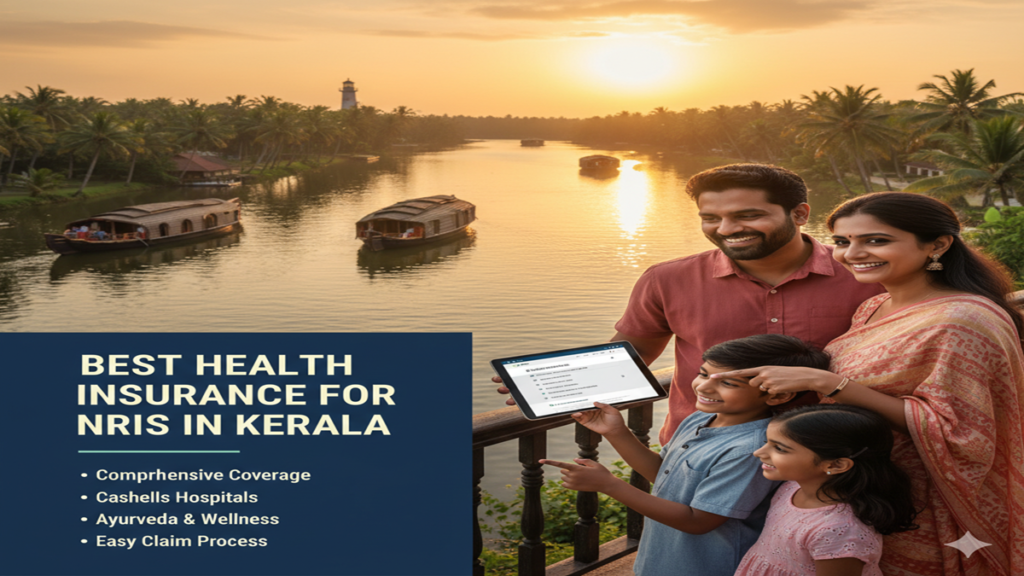
Best Health Insurance for NRIs in Kerala 2026: प्रवासियों के लिए केरल में सबसे अच्छे स्वास्थ्य बीमा प्लान; जानिए पूरी जानकारी!
Best Health Insurance for NRIs in Kerala 2026: Introduction: केरल को ‘प्रवासियों की भूमि’ कहा जाता है। दुनिया भर में फैले मलयाली प्रवासी (NRIs) न केवल देश की अर्थव्यवस्था में योगदान देते हैं, बल्कि अपने पीछे रह गए परिवार की सेहत और सुरक्षा की चिंता भी करते हैं। जब बात स्वास्थ्य की आती है, तो केरल के निजी अस्पतालों का स्तर विश्वस्तरीय है, लेकिन उनका खर्च भी काफी अधिक हो सकता है। इसीलिए, “Best health insurance for NRIs in Kerala” का चुनाव करना हर प्रवासी के लिए प्राथमिकता होनी चाहिए।
आज 2 अप्रैल 2026 की ताजा पॉलिसी दरों और नियमों के अनुसार, एनआरआई के पास सरकारी और निजी दोनों तरह के बेहतरीन विकल्प मौजूद हैं। इस लेख में हम उन टॉप इंश्योरेंस प्लान्स की चर्चा करेंगे जो केरल के प्रवासियों के लिए सबसे उपयुक्त हैं।
1. नोर्का रूट्स प्रवासी बीमा (Norka Roots Pravasi Insurance)
Best Health Insurance for NRIs in Kerala 2026: केरल सरकार की ‘नोर्का रूट्स’ (Norka Roots) योजना प्रवासियों के लिए सबसे सस्ता और प्रभावी विकल्प है।
- फायदे: यह योजना विशेष रूप से उन लोगों के लिए है जो ‘प्रवासी कल्याण निधि’ के सदस्य हैं। इसमें दुर्घटना, मृत्यु और गंभीर बीमारियों के लिए वित्तीय सहायता दी जाती है।
- किसे लेना चाहिए: उन प्रवासियों के लिए जो कम बजट में एक सरकारी सुरक्षा चक्र चाहते हैं।
2. स्टार हेल्थ एनआरआई रेड कार्पेट (Star Health NRI Red Carpet)
Best Health Insurance for NRIs in Kerala 2026: केरल में स्टार हेल्थ का नेटवर्क बहुत मजबूत है। उनकी ‘रेड कार्पेट’ पॉलिसी विशेष रूप से एनआरआई और उनके माता-पिता के लिए बनाई गई है।
- मुख्य विशेषताएं: इसमें पहले से मौजूद बीमारियों (Pre-existing diseases) के लिए वेटिंग पीरियड बहुत कम है।
- नेटवर्क: केरल के लगभग सभी बड़े अस्पतालों (जैसे Aster Medcity, Amrita, KIMS) में कैशलेस सुविधा उपलब्ध है।
3. केयर हेल्थ इंश्योरेंस – केयर फॉर एनआरआई (Care Health – Care for NRI)
Best Health Insurance for NRIs in Kerala 2026: केयर हेल्थ अपने ‘नो क्लेम बोनस’ और वार्षिक स्वास्थ्य जांच के लिए जाना जाता है।
- फायदे: यह प्लान विदेशों में इलाज के लिए भी विकल्प प्रदान करता है (वैकल्पिक)। यदि आप छुट्टियों में केरल आते हैं, तो यह आपको और आपके परिवार को व्यापक कवर देता है।
4. एनआरआई के लिए स्वास्थ्य बीमा चुनते समय ध्यान रखने योग्य बातें (Checklist)
- कैशलेस अस्पताल नेटवर्क: सुनिश्चित करें कि आपके होमटाउन (जैसे कोच्चि, तिरुवनंतपुरम, या कोझिकोड) के टॉप अस्पताल उस बीमा कंपनी के नेटवर्क में हों।
- माता-पिता का कवरेज: एनआरआई के माता-पिता अक्सर वरिष्ठ नागरिक होते हैं। ऐसी पॉलिसी चुनें जिसमें ‘को-पेमेंट’ (Co-payment) का क्लॉज कम से कम हो।
- ओपीडी (OPD) कवर: केरल में कई बार अस्पताल में भर्ती होने के बजाय ओपीडी खर्च ज्यादा होता है, इसलिए ओपीडी कवर वाली पॉलिसी बेहतर है।
- क्लेम सेटलमेंट रेशियो: हमेशा उस कंपनी को चुनें जिसका क्लेम सेटलमेंट रिकॉर्ड 95% से अधिक हो।
5. 2026 में एनआरआई बीमा के नए नियम
Best Health Insurance for NRIs in Kerala 2026: 2026 में, आईआरडीएआई (IRDAI) ने नियमों को और भी सरल बना दिया है:
- डिजिटल केवाईसी: अब आप विदेश में बैठकर अपने अंतरराष्ट्रीय नंबर से ही पॉलिसी खरीद और रिन्यू कर सकते हैं।
- टैक्स लाभ: भारत में भुगतान किए गए प्रीमियम पर धारा 80D के तहत ₹25,000 से ₹50,000 तक की आयकर छूट मिलती है (यदि आपकी भारत में आय है)।
4. अक्सर पूछे जाने वाले प्रश्न (FAQs)
Q1: क्या एनआरआई को भारत में स्वास्थ्य बीमा लेना चाहिए?
Ans: हाँ, क्योंकि विदेशी इंश्योरेंस भारत के अस्पतालों में कैशलेस सुविधा नहीं देते और भारतीय बीमा पॉलिसियां यहाँ के इलाज के खर्च के हिसाब से किफायती होती हैं।
Q2: केरल में सबसे अच्छा कैशलेस नेटवर्क किस कंपनी का है?
Ans: केरल में Star Health और HDFC Ergo का नेटवर्क सबसे व्यापक माना जाता है।
Q3: क्या नोर्का (Norka) बीमा पर्याप्त है?
Ans: नोर्का एक बेहतरीन बुनियादी सुरक्षा है, लेकिन बड़ी सर्जरी या गंभीर बीमारियों के इलाज के लिए एक अलग प्राइवेट हेल्थ इंश्योरेंस (कम से कम ₹10-15 लाख का कवर) होना जरूरी है।
Conclusion: सुरक्षित भविष्य, खुशहाल परिवार!
Best Health Insurance for NRIs in Kerala 2026: केरल के प्रवासियों के लिए Best health insurance वही है जो उनकी अनुपस्थिति में उनके परिवार को बिना किसी वित्तीय तनाव के सर्वश्रेष्ठ चिकित्सा सुविधा दिला सके। 2026 में विकल्पों की कमी नहीं है, बस आपको अपनी जरूरत और बजट के अनुसार सही संतुलन बनाना है। आज ही एक सही प्लान चुनें और अपनी मेहनत की कमाई को सुरक्षित करें।
Navigating Health Horizons: A Comprehensive Guide to the Best Health Insurance for NRIs in Kerala
Best health insurance for NRIs in Kerala For the Malayali diaspora scattered across the globe, the connection to Kerala—the lush green homeland—remains an indelible part of their identity. Whether you are an NRI (Non-Resident Indian) in the Gulf, the United States, Europe, or elsewhere, ensuring the health and well-being of your family back in Kerala is a paramount concern. Medical emergencies can arise unexpectedly, and the rising cost of healthcare in India makes having a robust health insurance plan not just a financial tool, but an act of care and responsibility.
Best Health Insurance for NRIs in Kerala 2026: Choosing the best health insurance for NRIs to cover their families or for themselves during visits to Kerala involves navigating a complex landscape of policies, regulations, and specific needs. This comprehensive guide, spanning 2000 to 3000 words, will illuminate the path, helping you make an informed decision to secure the best possible protection.
Part 1: Understanding the NRI Context and Why Specialized Insurance is Crucial
Best Health Insurance for NRIs in Kerala 2026: An NRI, as defined by the Foreign Exchange Management Act (FEMA), is an Indian citizen who resides outside India for employment, business, or any other purpose indicating an indefinite stay. This unique status creates distinct insurance needs:
- Dual Geography Risk: Your family resides in Kerala, while you might be continents away. You need a policy that works seamlessly in your hometown, potentially in tier-2 or tier-3 cities like Thrissur, Kollam, or Palakkad, not just in major metros.
- Frequent Visits: You likely visit Kerala periodically. A good plan should offer coverage not just for your family but also for you during your stay, possibly with a “Visit India” cover extension.
- Cashless Hospital Network: In an emergency, your family shouldn’t struggle with large cash payments. A wide network of cashless hospitals across Kerala, including reputable private hospitals like Aster, MIMS, Lakeshore, and Amrita, is non-negotiable.
- Claim Settlement from Abroad: The entire process of filing claims, submitting documents, and tracking progress should be manageable remotely, without requiring physical presence.
- Currency and Payment: Premium payments are often in INR, but you need convenient options from your country of residence (forex, NRE/NRO accounts, international cards).
The Kerala Healthcare Context: Kerala boasts excellent medical facilities but also has some of the highest medical costs in India. The prevalence of lifestyle diseases and the need for advanced treatments make adequate sum insured a critical factor. A policy that covers treatments in both major corporate chains and trusted local specialty hospitals is ideal.
Part 2: Key Features to Look for in the Best Health Insurance for NRIs
Best Health Insurance for NRIs in Kerala 2026: When evaluating plans, go beyond just the premium. Scrutinize these features:
1. Scope of Coverage:
- In-Patient Hospitalization (IPD): The core cover. Ensure it includes room rent, ICU charges, surgeon fees, anesthesia, medicine, and diagnostic tests.
- Pre and Post-Hospitalization: Covers expenses for consultations, tests, and medicines before (typically 30-60 days) and after (60-90 days) hospitalization.
- Day Care Procedures: Covers treatments like chemotherapy, dialysis, or cataract surgery that don’t require 24-hour hospitalization.
- Ambulance Cover: Adequate cover for emergency ambulance services.
- Organ Donor Expenses: Covers the medical costs associated with the donor during a transplant procedure.
- Modern Treatments: Coverage for advanced treatments like robotic surgery, stem cell therapy, or oral chemotherapy is essential.
- Ayush Treatment: Coverage for Ayurveda, Homeopathy, etc., can be a valuable add-on given Kerala’s affinity for traditional medicine.
2. Sum Insured and Restoration Benefit:
- Best Health Insurance for NRIs in Kerala 2026: Adequate Sum Insured: For a family, a sum insured of at least ₹10-15 lakhs is recommended. For older parents, consider ₹20-25 lakhs or more due to higher risk. Some insurers offer plans up to ₹1 crore or more.
- Restoration Benefit: This feature automatically reinstates the sum insured if it is exhausted in a claim during the policy year. Some policies offer unlimited restoration for unrelated illnesses, a highly beneficial feature.
3. Network Hospitals in Kerala:
Best Health Insurance for NRIs in Kerala 2026: This is arguably the most critical factor. The insurer must have a wide and reputable network across all districts of Kerala. Verify the list for hospitals in your specific city/village and major referral centers in Kochi, Thiruvananthapuram, and Kozhikode.
4. Claim Settlement Process & Support:
- 24/7 NRI Helpdesk: A dedicated, toll-free helpline for NRIs based in your time zone.
- Online Claim Intimation & Tracking: A seamless digital portal and mobile app.
- Easy Documentation: Minimal, clearly listed documents required for claim submission, with options for email/upload.
- High Claim Settlement Ratio (CSR): Look for insurers with a consistent CSR above 90-95%. This indicates reliability.
5. Flexibility and Add-ons (Riders):
- Critical Illness Rider: Pays a lump sum amount on diagnosis of specific critical illnesses (like cancer, stroke, heart attack). This is crucial as it provides a financial cushion beyond hospitalization costs.
- Personal Accident Rider: Provides coverage for accidental death or disability.
- Top-up/Super Top-up Plans: For enhancing coverage beyond the base plan at a lower cost.
- Maternity Cover: If planning for a family addition during your stay in India.
6. Policy Terms Specific to NRIs:
- Best Health Insurance for NRIs in Kerala 2026: “Visit India” Cover: Some policies automatically cover the NRI proposer for a limited period (e.g., 30-90 days) during visits to India. Check the duration and terms.
- Medical Check-up Requirements: These might be mandatory for higher sum insured or older ages. Understand if they can be done in Kerala or your country of residence.
- Ensure smooth renewal reminders and processes.
Part 3: Top Health Insurance Providers for NRIs (A Comparative Overview)
Best Health Insurance for NRIs in Kerala 2026: Here’s a look at some of the leading insurers known for their NRI-friendly policies and strong networks in Kerala:
1. Niva Bupa (Formerly Max Bupa):
- Strengths: Renowned for customer-centric policies, a vast network including most major hospitals in Kerala, and high claim settlement ratio. Their “Reassure” and “Health Companion” plans are popular. They offer comprehensive coverage for modern treatments and have a robust digital platform.
- NRI Focus: Smooth policy issuance for NRIs, dedicated support, and good flexibility in sum insured options.
2. HDFC ERGO:
- Best Health Insurance for NRIs in Kerala 2026: Strengths: Offers a range of plans like “Optima Restore” and “My:Health Suraksha”. Known for a wide network and efficient claim settlement. Their “Health Suraksha” plan is often recommended for its balance of coverage and cost.
- NRI Focus: Has specific provisions for NRIs, including easy online purchase and management.
3. ICICI Lombard:
- Best Health Insurance for NRIs in Kerala 2026: Strengths: Strong digital infrastructure and a extensive hospital network across India, including deep penetration in Kerala. Plans like “Health Advantage Plus” offer comprehensive coverage.
- NRI Focus: Provides dedicated assistance for NRIs and allows for easy online policy management from abroad.
4. Star Health Insurance:
- Best Health Insurance for NRIs in Kerala 2026: Strengths: Specializes in health insurance and has a very strong presence in South India, including Kerala. Their “Senior Citizen Red Carpet” plan is tailored for older parents. They also offer a unique “Medi-Classic” plan.
- NRI Focus: They have experience dealing with NRI clients, especially from the Gulf region, and understand the Kerala market intimately.
5. Aditya Birla Health Insurance:
- Best Health Insurance for NRIs in Kerala 2026: Strengths: Innovative with plans like “Activ Health” that reward healthy behavior with wellness benefits and restoration of sum insured. Good network coverage.
- NRI Focus: Provides options for NRIs to secure coverage for their families in India.
6. Care Health Insurance (Formerly Religare):
- Best Health Insurance for NRIs in Kerala 2026: Strengths: Known for competitive pricing and comprehensive plans like “Care Freedom”. Has a substantial network and offers good value for money.
- NRI Focus: Facilitates policy purchase and service for NRIs.
7. The New India Assurance (Public Sector):
- Best Health Insurance for NRIs in Kerala 2026: Strengths: Unmatched network reach, even in remote areas of Kerala. High trust factor. Plans like “Mediclaim” are straightforward.
- NRI Focus: As a government company, it has longstanding schemes for Indians abroad. The process can be less digital but is highly reliable.
Part 4: Step-by-Step Guide to Choosing and Buying a Policy
- Best Health Insurance for NRIs in Kerala 2026: Assess Needs: List the family members to be covered, their ages, medical history, and your hometown in Kerala. Decide on the required sum insured.
- Shortlist Insurers: Based on the features above, shortlist 3-4 insurers with strong Kerala networks and NRI support.
- Compare Plans: Use aggregator websites (like Policybazaar, Coverfox) or consult with an NRI-specialized insurance advisor to get detailed comparisons of coverage, exclusions, premiums, and network hospitals in your specific locations.
- Read the Policy Wordings: This is vital. Carefully read the exclusions, waiting periods (especially for pre-existing diseases, which can be 2-4 years), sub-limits on room rent, and specific terms for diseases common in Kerala.
- Best Health Insurance for NRIs in Kerala 2026: Disclose Medical History Honestly: Never hide pre-existing conditions. It may lead to claim rejection later. Accept the applicable waiting period.
- Choose Payment Method: Pay via NRE/NRO bank account, forex card, or international credit/debit card. Keep proof of payment.
- Digitize and Store Documents: Keep soft copies of the policy document, proposal form, payment receipt, and communication with the insurer in a secure, accessible cloud folder.
Part 5: Managing Claims and Renewals from Abroad
- Best Health Insurance for NRIs in Kerala 2026: At Time of Hospitalization: Your family should immediately call the insurer’s 24/7 helpline and the TPA (Third Party Administrator) to intimate the claim and get pre-authorization for cashless treatment at a network hospital.
- Documentation: After discharge, ensure your family collects and scans all original documents: signed claim form, discharge summary, all bills and receipts, medicine prescriptions, and test reports.
- Submission: Upload these to the insurer’s portal or email as instructed. Follow up via the helpline and online tracking.
- Renewals: Opt for auto-debit from your NRO account or set calendar reminders. Never let the policy lapse, as it will result in loss of cumulative benefits like waiting period completion.
Conclusion: Peace of Mind Across the Seas
Best Health Insurance for NRIs in Kerala 2026: For the NRI community from Kerala, a well-chosen health insurance policy is more than a financial product; it is a bridge of security spanning the miles. It ensures that when a health crisis strikes, your loved ones have access to the best care without financial distress, and you can manage the situation effectively from afar.
Invest time in research, prioritize network and claim support over the lowest premium, and choose a plan that aligns with your family’s specific reality in Kerala. The right health insurance is your silent guardian, offering the priceless gift of peace of mind, allowing you to nurture your dreams abroad while keeping your roots strong and secure back home.
FAQ: Best Health Insurance for NRIs in Kerala
Q1. Can I, as an NRI, purchase health insurance for my parents/siblings living in Kerala?
Best Health Insurance for NRIs in Kerala 2026: A: Yes, absolutely. You can purchase a policy where you are the proposer/policyholder (paying the premium) and your parents, spouse, children, or dependent siblings in Kerala are the insured members. You will need their details and consent, and the policy will be issued in their name(s) for their coverage in India.
Q2. Are pre-existing diseases (PEDs) like diabetes or hypertension covered?
Best Health Insurance for NRIs in Kerala 2026: A: Yes, but after a specified waiting period, which is typically 2 to 4 years, depending on the policy and insurer. It is mandatory to declare all PEDs at the time of application. Coverage will begin for these conditions only after the waiting period is served continuously without a break in the policy.
Q3. What happens if I am in Kerala and need medical treatment? Am I covered under my family’s policy?
A: It depends on the policy terms. Many family floater or individual policies taken for family in India do not automatically cover the NRI proposer. However, many insurers offer a “Visit India” cover as an add-on or built-in feature, which covers the NRI for a short period (e.g., 30-60 days) during their visit. You must confirm this feature before purchasing.
Q4. How do I pay the premium from abroad, and are there any tax benefits?
A: You can pay easily using your NRE/NRO bank account via net banking, international credit/debit cards, or forex instruments. Regarding tax benefits under Section 80D of the Income Tax Act, an NRI can claim a deduction for premiums paid for health insurance of parents (resident Indian citizens) if the NRI files taxes in India. If you don’t file in India, you cannot claim the benefit, but your insured parents might be able to claim it on their IT return if they are taxpayers.
Q5. What is the single most important thing to check in a policy for Kerala?
A: The network of cashless hospitals in your specific hometown and nearby major cities in Kerala. Verify the insurer’s hospital list for the exact names and locations of hospitals you trust. A wide network ensures easy access to cashless treatment in an emergency, which is the primary utility of the insurance for your family.